
CAO MESSAGE
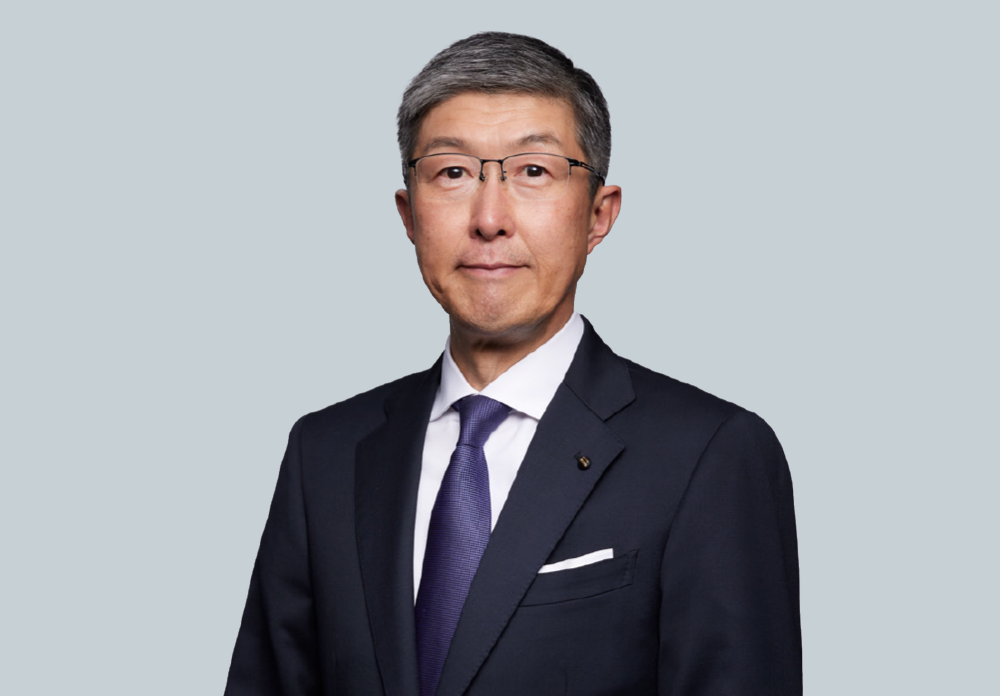
Strengthening Our Human and Organizational Resources under a Market-in Approach, and Supporting the Sustainable Enhancement of the ITOCHU Group’s Corporate Value
Member of the Board, Senior Executive Officer, CAO*
Tomokuni Nishiguchi
* Chief Administrative OfficerAs CAO, Putting Our Market-in Approach into Practice
I assumed the role of CAO this year, after spending the previous five years as General Manager of the Secretariat, where I coordinated with top management and had direct exposure to the state of ITOCHU’s management and our leadership’s thinking. In particular, working closely with Chairman & CEO Okafuji allowed me to fully absorb the market-in approach, one of our key management philosophies. I also have secondment experience at an ITOCHU Group company in the retail business, where I experienced the market-in approach on the front-lines as we listened carefully to customers’ voices and responded flexibly to change.
I am committed to enhancing ITOCHU’s management foundation from the non-financial perspective together with the members of the Corporate Communications, Human Resources & General Affairs, Legal, and Sustainability Management Divisions that fall under the CAO’s purview. By fostering a market-in approach that remains close to both internal and external stakeholders, we will support ITOCHU’s “gear shift.”
People and Organizations that Respond to Change
Our human capital strategy must be designed with a long-term perspective, remaining flexible enough to respond to future business opportunities and various changes in the environment. Even when unforeseen events occur, such as the recent closure of the Strait of Hormuz, as merchants we must continue to operate on the front-lines in countries around the world. It is thus essential to detect changes on the ground before such situations arise. We must operate with a global perspective, constantly reassessing where to dispatch rotational staff and which languages to have our employees learn. Developing global talent means cultivating people who take a long-term perspective, building local networks and understanding cultures and systems, while driving business at the local level. This may be the age of AI, but only people can accumulate trust on the ground, build close relationships, and move business forward.
In addition, because overseas offices often operate with limited personnel, individuals may be required to contribute beyond the boundaries of vertical structures that exist at headquarters. Such situations create opportunities for ITOCHU to fully employ its diverse knowledge and functions from a broad, global perspective.
Promoting women’s advancement is also crucial to building an organization that is responsive to change. Ever since our full-scale recruitment and development of women in careertrack positions began, the pipeline of future leadership talent has grown steadily stronger. To further enhance diversity at the management level, it is necessary to provide systematic support for both development and promotion. To this end, we have introduced special measures to appoint a certain number of female executive officers, focusing primarily on internal talent development rather than relying excessively on external appointments, to diversify our management. To date, a total of 12 women have been promoted internally to executive officers. All of them have delivered strong results, building on varied experiences that extend beyond conventional career paths, from business to corporate divisions, and from domestic to overseas assignments. This not only fosters individual growth, it also offers visible role models to the next generation, creating a virtuous cycle that encourages bold new steps. I believe that enhancing diversity at the management level through internal talent development represents ITOCHU’s distinctive approach to strengthening human capital, and will contribute to enhancing corporate value over the medium- to long-term.
The use of AI is also bringing significant changes to the way we work. There are certainly areas, such as routine tasks, data aggregation, and contract review, where AI should be used to improve efficiency. However, we should not leave matters such as accountability for management decisions or decisions on personnel transfers to AI. Our management will remain human-led, and the boundary between what should be entrusted to AI and what should remain in human hands will differ by organization based on the broad range of industries in which ITOCHU works. By making effective use of AI, we aim to further enhance the labor productivity we have long emphasized, while preserving the high-quality management decisions we are proud of at ITOCHU.
Driving Profit Growth through Our Group’s Collective Strength
Enhancing our Group’s collective strength is essential to increasing corporate value. In FY2025, 87% of consolidated net profit was generated by Group companies. The key to further enhancing the corporate value of the ITOCHU Group lies in raising its growth potential as a whole. Our aim is to have talent, knowledge, values, and management philosophy circulate between ITOCHU Corporation and Group companies. It is not enough to simply send personnel from headquarters to Group companies; it is also very meaningful to welcome outstanding talent from Group companies to headquarters, where they can acquire ITOCHU’s management philosophy and a broad perspective on what is best for the Group as a whole, and take this knowledge back to their companies. This cycle will go beyond merely sharing philosophy, strengthening the management foundation of the entire Group and linking the growth of each company to growth in the Group’s profit as a whole.
Our Group’s collective strength is also highly significant in securing talent. During the peak season for new graduate recruitment, the ITOCHU Group ran joint advertisements featuring 24 Group companies through FamimaTV, the digital signage displayed in the stores of FamilyMart, a Group company. These advertisements generated strong interest, particularly among people in their teens and 20s, and produced effective results for the participating Group companies. Human resources managers across the Group have noted that holding events as the ITOCHU Group, rather than conducting information sessions individually, helps attract a larger number of highcaliber candidates. This is another example of a Group-wide approach to talent acquisition strategy.
Through such initiatives, we will further strengthen the cohesion of the ITOCHU Group and connect it to further growth.
Advancing Sustainability through Our Core Businesses
While the market’s basis for evaluating sustainability may fluctuate, issues such as the environment, human rights, local communities, and supply chain stability will remain critical to business continuity over the long-term. The key is not to view sustainability as an additional cost separate from our core business, but to convert it into competitiveness within our business. It is equally important to communicate ITOCHU’s distinctive approach to sustainability clearly to all stakeholders across society. Our strengths in the consumer-related sector enable us to implement sustainability initiatives in ways that are more approachable and readily felt by society than other companies. Our market-in approach is also important in sustainability, and we see our ability to translate sustainability into value that is easy for society and consumers to understand as one of our competitive advantages.
For example, Dole Japan’s Mottainai Banana initiative reduces food loss by selling bananas that, while having no issues in quality, would otherwise have been discarded for superficial blemishes or size standards. It is an excellent example of how we can present solutions to social issues through our core business. The same can be said of our energy-from-waste business in Serbia. This business emerged from the expertise we have cultivated over many decades in the plant development field, particularly in water treatment and power generation. In Serbia, where waste management is a pressing issue, combining waste treatment with power generation enables us to contribute to GHG emissions reductions and improvement in the surrounding river environment, while also creating new revenue opportunities. There are many similar examples at the ITOCHU Group which advance sustainability through our core business, balancing environmental and social value with economic value. We look forward to sharing more of these initiatives in an accessible manner with you going forward.
Sustainable businesses do not emerge overnight. Rather, the accumulation of business experience on the front-lines brings us into contact with social issues there, and the initiatives taken in response create the foundation for sustainable business. As seen with Dole and our energy-from-waste business, sustainability can be converted into a competitive strength by delving into our core business and incorporating responses to social issues. I believe that ITOCHU’s distinctive approach to sustainability balances both social and economic value, with business as the starting point.
Working Together as ITOCHU Group to Achieve a “Gear Shift”
As of this year, 100% of employees have joined the Employee Shareholding Association. This demonstrates that every employee is not only an employee but also a shareholder, and that a foundation is in place for everyone to view the enhancement of corporate value as their business. Moreover, over 30% of participants hold assets valued at over ¥20 million. This is an exceptionally high proportion even among peer companies with similar sizes and market capitalizations, demonstrating numerically that employees are truly sharing in ITOCHU’s growth.
Precisely because we are a lean organization, it is important that each individual brings both a management and shareholder perspective, and deploys their skills towards the same goal. As CAO, I will continue to emphasize our marketin approach, strengthening individual employee performance as well as the foundation of organizational coherence, connecting our “gear shift” with the sustainable expansion of corporate value.
- “Sampo-yoshi” and Management Philosophy
- Management Message
- Value Creation
- Mechanisms and Practices of Value Creation
—Business Model— - On the Front Lines of Value Creation
- Corporate Governance
- Corporate Governance System
- Board Effectiveness Evaluation
![[PDF]](/en/common/img/com_pdf_ic01.png)
- List of Directors and Audit & Supervisory Board Members
- Director Selection Criteria / Succession Planning
- Messages from Outside Directors and Audit & Supervisory Board Members
- Corporate Officer Remuneration
- Policy on the Governance of Listed Subsidiaries and Affiliates
- Data / Dialogue with Stakeholders