
CFO MESSAGE
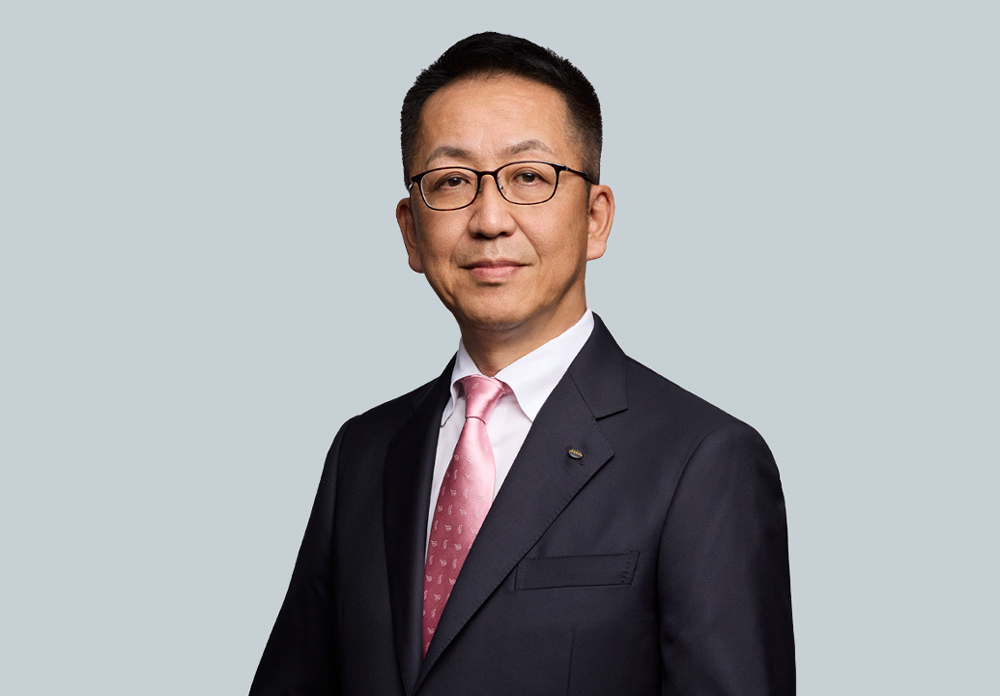
As a CFO who can clearly explain the direction ahead, I will firmly fulfill my role as part of management and continue to support the sustainable enhancement of corporate value.
Member of the Board,
Senior Executive Officer, CFO; CXO
Hiroyuki Naka
A CFO Who Can Clearly Explain the Management Policy
I was appointed CFO this fiscal year, at a time when we are aiming to achieve a step-change in earnings through a “gear shift.” As I engage in dialogue with the market as the new CFO, I am keenly aware of significant responsibilities that come with the role.
There is one point I would like to emphasize at the beginning. Like my predecessor, I believe a CFO must be able not only to explain financial matters but also to assume part of the role expected of a Chief Strategy Officer (CSO) when engaging with the market. In 2018, I was appointed General Manager of the Corporate Planning Division, with responsibility for Companywide corporate planning. Since 2022, as CSO, I have led the formulation and execution of our Companywide management strategies. Since 2024, as Chief Transformation Officer (CXO), I have led the transformation of our business portfolio and business models across the ITOCHU Group. A world-class CFO must not only understand past performance but also take responsibility for the management strategy. Based on my experience, this is the standard I set for myself as CFO.
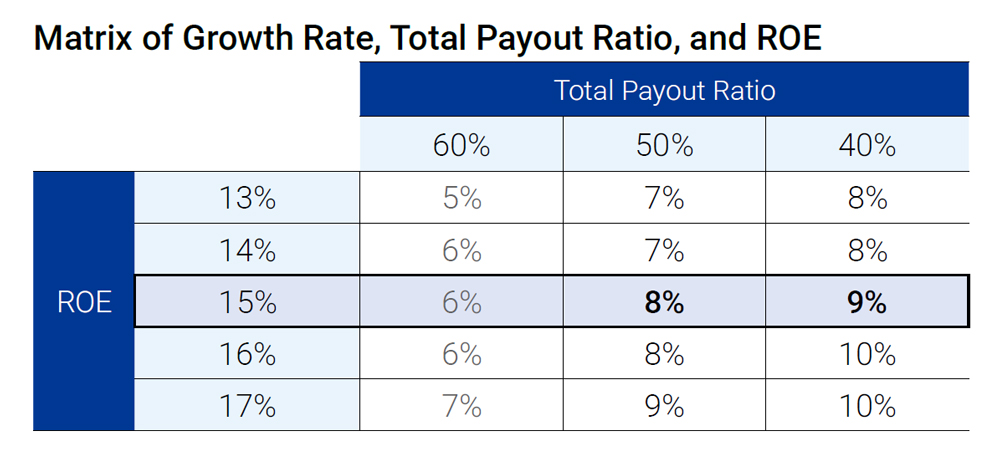
Enhancing corporate value requires both earnings growth and strong capital efficiency, as reflected in EPS and ROE. As indicated by the financial matrix, I believe that maintaining a total payout ratio of around 50%, in line with the level we have delivered in recent years, and achieving profit growth of 7% to 8% as our minimum target would enable us to sustain ROE at the 15% level, which I believe is a global standard. The role of the CFO is to execute financial strategy, take responsibility for the future management strategy and turn value creation into measurable results. With this conviction, I will fully commit to fulfilling my role as CFO.
1 : Capital Allocation to Enhance Corporate Value
There is no change to our long-standing financial policy of maintaining a solid financial foundation based on balancing three factors: growth investments, shareholder returns, and control of interest-bearing debt. At the same time, while maintaining financial discipline, capital allocation should be managed flexibly in response to the changes in the business environment and management conditions. As of March 31, 2026, NET DER had improved to 0.46 times, and our financial foundation is robust. Provided we maintain our current high credit ratings, I believe we still have sufficient debt capacity. We are now in a position to consider the use of financial leverage as one of our strategic options.
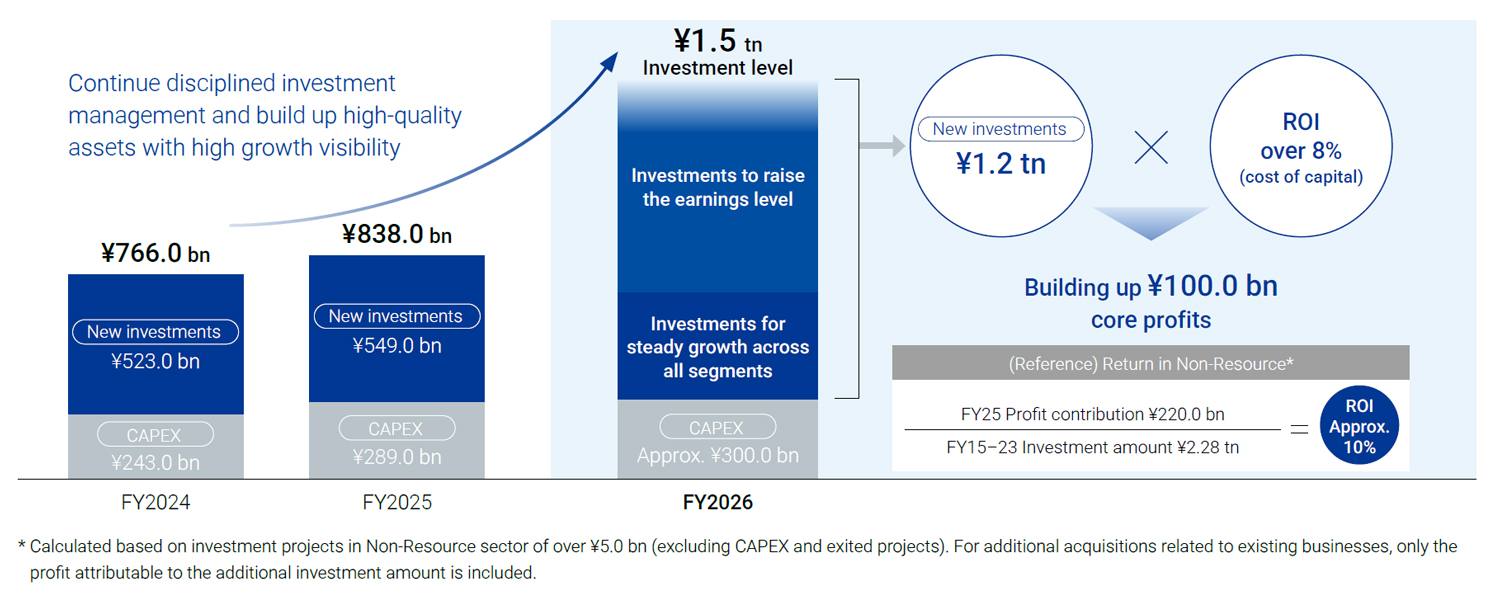
In this fiscal year, our top priority is to actively pursue growth investments in order to raise our earnings level. Compared with the level of ¥700.0 billion to ¥800.0 billion in growth investments over the past two years, we are planning growth investments on the scale of ¥1.5 trillion, roughly double that level. This figure is not a preset allocation. In addition to investments already executed, multiple projects are already including several transactions that have reached an agreement in principle and are now in the final stages of negotiations. In other words, this amount is supported by a pipeline of specific projects. Based on our assessment that our current cost of capital is approximately 8%, we intend to steadily build a portfolio of growth investments capable of generating ROI above 8%. Through the execution of these proactive growth investments, we expect to increase core profit by at least ¥100.0 billion in the near future.
At the same time, let me state clearly that we have no intention whatsoever of relaxing investment discipline in order to accelerate growth investments. Japan is clearly moving into a higher interest-rate environment. Based on our approximately 70 business-specific hurdle rates currently in place, we carefully assess required returns based on the cost of capital. Over the past two years, I have personally chaired the Investment Consultative Committee and conducted this review process carefully. We have focused not only on valuation at the time of investment but also on future business expansion and creating new growth opportunities by realizing synergies after an investment. For example, creating synergies requires diverse insights and the building of practical, executable structures. Ensuring that each project can develop into a future earnings pillar is a key part of the CFO’s role. By taking these efforts to the next level, we will accelerate growth investments with clear visibility on profit contribution.
On the other hand, the importance of shareholder returns remains unchanged. After extensive discussions within management, we have established our current shareholder returns policy. With regard to dividends, we have once again clearly stated a progressive dividend policy in our long-term Management Policy. In doing so, we have made clear our commitment to maintain progressive dividends in line with profit growth, without reducing them. For this fiscal year, we plan dividends of ¥44 per share or more, marking the 12th consecutive year of dividend increases. In addition, we plan share buybacks for the 11th consecutive year, at ¥300.0 billion or more, representing a record high. As a result, our initial forecast for the total payout ratio stands at 64%.
Implementing capital allocation that contributes to enhancing corporate value, based on the financial matrix we have consistently presented, is one of my most important responsibilities as CFO.
2 : Our Continued Focus on High ROE
My view remains unchanged that an ROE level of 15% is a key benchmark for being favored by global investors, including overseas institutional investors. Among large-cap companies in Japan, those that have maintained ROE above 15% over many years are extremely rare, and I believe this has been a key factor behind ITOCHU’s strong market valuation. In my view, the relatively high proportion of overseas investors in our shareholder base is further evidence that this strength has been recognized by global investors. This is a core principle that we should continue to value. It is also one of the most important principles I have inherited from my predecessor.
Some investors may be concerned that ROE could gradually decline going forward. As we have shown through our financial matrix, the key question is how to balance profit growth and shareholder returns. This is one of the most important responsibilities of the CFO. However, we will not pursue simplistic measures that raise ROE merely by excessively reducing shareholders’ equity. In such an uncertain business environment, maintaining a sufficient risk buffer by strengthening shareholders’ equity is also essential from a long-term management perspective. This also supports stable access to funding. Ultimately, simplistic measures do not lead to sustainable enhancement of corporate value over the long term.
At the same time, in order to maintain high ROE, we will pursue proactive asset replacement. I personally led the sale of CPP in FY2025. Even when low-efficiency assets and businesses that have already passed their peak continue to generate a certain level of profit, we must carefully assess them as candidates for replacement. Through the sale of CPP, I sought to demonstrate that stance in practice. By capital recycling, we can secure cash and redirect those funds into new growth areas. This kind of proactive asset replacement is something I will continue to promote as CFO as we work to maintain high ROE.
Furthermore, we will move into a higher gear in our efforts to improve the efficiency of our business portfolio. In FY2025, ROA in the non-resource sector was approximately 5.5%, while the resource sector, despite including projects that required turnaround, recorded ROA of 8.6%. This suggests that there is still considerable room for improvement in efficiency on a Companywide basis. As a first step, through the ALM Committee, which I chair, I will drive initiatives to raise ROA in the non-resource sector above 6%.
In terms of our overall portfolio, management’s current view is that the optimal mix for ITOCHU is 90% non-resource and 10% resource on an asset basis, and 75–80% non-resource and 20–25% resource on a profit basis. Because resource assets are depleting in nature, their share will decline unless we continue to replenish them to a certain extent. At times, the resource sector delivers high ROA, and it can also contribute to improving overall asset efficiency. We do not intend to increase the resource ratio excessively. However, maintaining an optimal Companywide portfolio balance is essential for the sustainable enhancement of corporate value.
By taking these initiatives a step further, we will continue to improve Companywide ROA and make appropriate use of leverage to firmly sustain a high level of ROE. High ROE remains one of the key drivers of corporate value enhancement for ITOCHU.
3 : Our Valuation and Market Perception
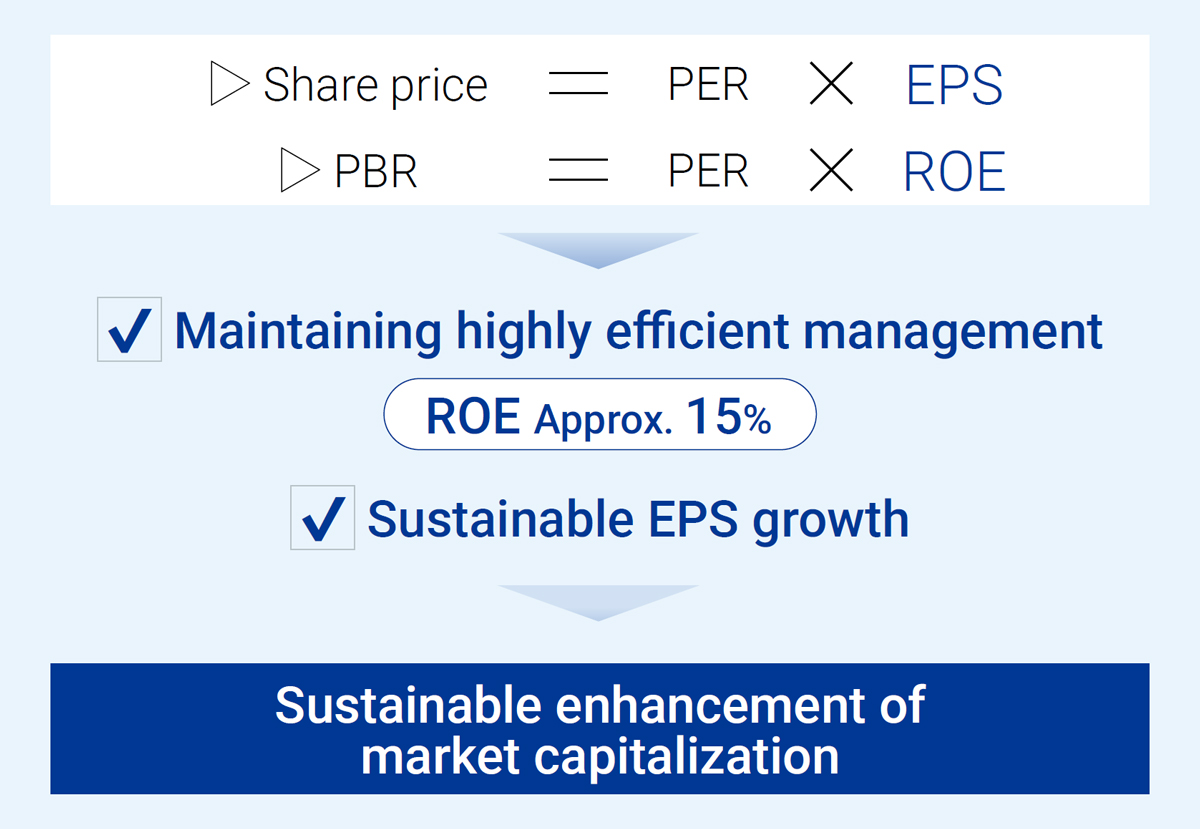
Since assuming the role of CFO, I have frequently been asked by investors how I view ITOCHU’s current share price. I recognize that this reflects concern that our stock performance has recently lagged somewhat, and I take these questions very seriously. There are various ways to assess valuation, including metrics such as Share price = PER × EPS and PBR = PER × ROE. More recently, some companies have even started to set specific market capitalization targets. Against this backdrop, I would like to outline my views on how valuation should be understood.
When considering share price, PER is a major factor, as it reflects market expectations. However, it is determined by the market and not something we can control directly. I believe growth expectations develop naturally when investors understand our profit growth story. As CFO, I will continue to clearly articulate the drivers of our growth. In my view, there are three core approaches to driving ITOCHU’s profit growth.
Three Approaches to Profit Growth
- Execution of Growth Investments with High Visibility on Profit Contribution
Already in this fiscal year, we have executed several projects with high visibility on profit contribution, including the additional acquisition of Hitachi Construction Machinery shares and the securing of additional earnings opportunities in the North American power business. We will continue to invest in core businesses that support the growth of each segment. - Cross-Sector Collaboration and Reorganization Leveraging Existing Businesses
Growth is not driven by investments alone. By combining ITOCHU’s business platform with the expertise and functions of new partners, we can expand beyond the boundaries of our business areas. For example, our strategic alliance with JR East in the real estate sector should further accelerate growth by combining the strengths and know-how of both companies. We aim to expand not only in real estate but also across a broad range of business areas. - Driving Growth in Areas of Deep Expertise: Hands-on Management and Market-in Approach
Businesses that now form the core of ITOCHU, such as DESCENTE, CTC, and FamilyMart, all achieved dramatic improvements in growth potential through additional acquisitions or privatization, combined with hands-on management. I believe there are still many such opportunities ahead of us.
Together with Our Stakeholders: Toward Further Enhancement of Corporate Value
My mission as CFO is to continue delivering both a high level of ROE and sustainable EPS growth, while articulating a growth story unique to ITOCHU, thereby earning a valuation that reflects our true value.
To that end, my conviction remains unchanged: dialogue with investors is the engine of corporate value enhancement. As a CFO committed to enhancing corporate value in concert with our investors, I will deliver on the commitments outlined here. At the same time, I will lead ITOCHU into its next stage of growth and deliver further enhancement of corporate value.
- “Sampo-yoshi” and Management Philosophy
- Management Message
- Value Creation
- Mechanisms and Practices of Value Creation
—Business Model— - On the Front Lines of Value Creation
- Corporate Governance
- Corporate Governance System
- Board Effectiveness Evaluation
![[PDF]](/en/common/img/com_pdf_ic01.png)
- List of Directors and Audit & Supervisory Board Members
- Director Selection Criteria / Succession Planning
- Messages from Outside Directors and Audit & Supervisory Board Members
- Corporate Officer Remuneration
- Policy on the Governance of Listed Subsidiaries and Affiliates
- Data / Dialogue with Stakeholders