
COO MESSAGE
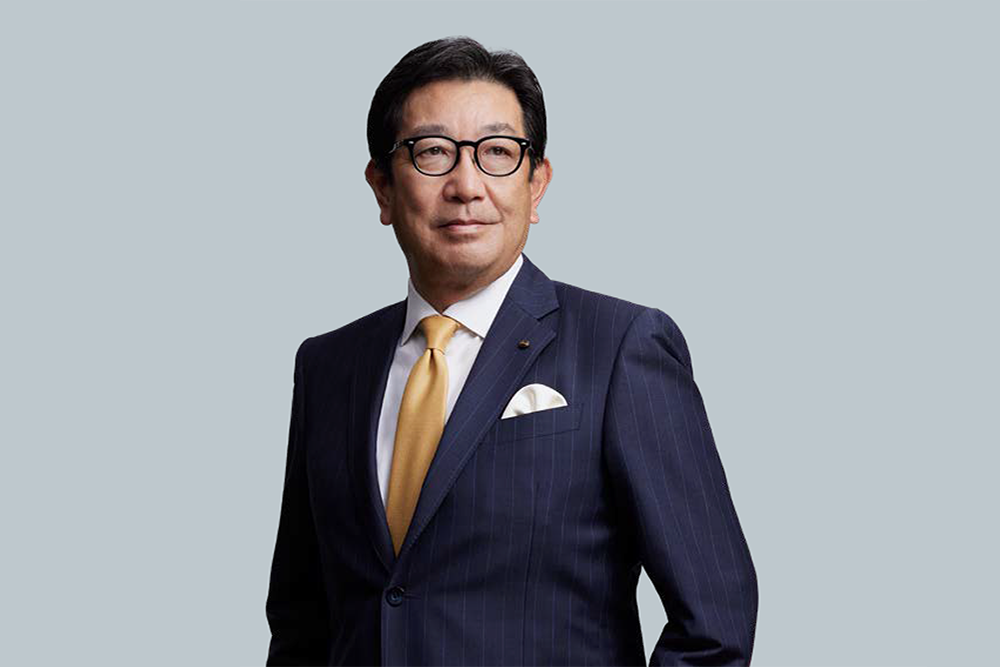
Creating New Value
Through the “Gear Shift”


Keita Ishii
President & Chief Operating Officer; CSO
FY2026: The Year of a “Gear Shift”
It has already been five years since I assumed the position of President & Chief Operating Officer in April 2021. During that time, I have worked tirelessly to meet the expectations of our many stakeholders by visiting the front lines in Japan and overseas and doing everything in my power to drive the growth of the ITOCHU Group.
Today, the world is in an unprecedented state of uncertainty and turmoil, shaped by developments such as the Trump administration’s challenge to the existing global order and wars and conflicts in various regions. At the same time, Japan, where ITOCHU has a substantial business base, is entering a period of major transformation. Japan is finally emerging from prolonged deflation and entering an inflationary environment for the first time in more than 30 years. Corporate governance reform is also gathering momentum and is pressing companies to transform themselves. Meanwhile, advances in AI and digital technologies continue at an extraordinary pace. We also see growing signs that domestic investment in Japan will accelerate, driven by government initiatives on economic security and national resilience. Against this backdrop of change in Japan, I also sense that overseas investors are paying closer attention to Japanese companies.
Over the past 15 years, our consolidated net profit has grown at a CAGR of more than 10%. However, to continue growing, we need a gear shift to move to the next stage. As we enter this period of major transformation, I am concerned that simply extending past ways of thinking may lead us to a dead end. We need to shift our thinking boldly-beyond vertical silos and toward broader, more multidimensional perspectives. For example, if we want to move beyond simply adding up multiple ¥1 billion profit opportunities and instead create profit on the order of ¥10 billion, we need a much bolder approach to partners, business domains, and business models.
That is why we have positioned FY2026 as the year for a “gear shift” and decided to step up growth investments significantly to the ¥1.5 trillion level. These investments are focused on creating new core businesses that will become future earnings drivers, while also generating new value from the front lines. That said, while our growth ambitions are rising, the way we will achieve that growth has not changed. It remains rooted in ITOCHU’s way of building earnings.
How ITOCHU Builds Earnings at the Front Lines
Chairman & CEO Okafuji often says, “Merchants need to be adaptable like water.” I believe this captures how we should approach business in an era of rapid and unpredictable change. Just as water freely changes its shape to fit the vessel that contains it, we must be agile in sensing changes in society and industry, respond with flexibility, and create new value. Guided by this distinctive merchant philosophy and by engaging deeply with society and industry, ITOCHU has steadily expanded its business. Over many years, we have built a deep presence in the front lines of a wide range of industries, built solid business foundations and networks of trust both inside and outside ITOCHU, and steadily honed the front-line capability of each employee. This is the essence of ITOCHU’s way of building earnings.
A distinctive strength of ITOCHU is its front-line capability—its ability to identify business opportunities by being close to our customers. In particular, our business platforms connect the entire value chain from downstream consumer touchpoints to midstream and upstream operations. The broad and various networks we have built across industries, are also a result of this front-line capability.
One of the clearest expressions of this front-line capability is our Hands-on management. We dispatch management personnel and employees with relevant functional expertise from ITOCHU to work closely with investees on the ground, identify key issues, and improve corporate value through management reform. Employees seconded to management roles at Group companies are not there simply in name or on a short-term basis. Our personnel system provides incentives in evaluation and compensation that are clearly linked to performance. This creates a virtuous cycle. Employees return to ITOCHU as stronger management talent, bringing with them real on-the-ground experience and insight. At the same time, ITOCHU retains the know-how gained through both successes and setbacks.
Chairman & CEO Okafuji and I hold meetings twice a year with the management teams of our major Group companies. In these meetings, we receive performance updates and discuss strategy from both medium- to long-term and short-term perspectives, taking into account the business environment surrounding each company. We are often presented with examples of creative ideas drawn from consumer touchpoints and bold initiatives that enhance corporate value. These meetings confirm that our core business principles “Earn, Cut, Prevent” and a “Market-in approach” are being put into practice across our Group companies, and that the ITOCHU’s way of building earnings has taken root there. Their contribution to earnings speaks for itself. In FY2025, approximately 70 Group companies, around 30% of all Group companies, achieved record-high profits, giving me real confidence in our future growth. For the growth of the ITOCHU Group, these Group companies —sharing the same philosophy, perspective, and determination to achieve ambitious goals— are truly irreplaceable assets, treasures that support the growth of the ITOCHU Group.
Creating New Value through Horizontal Collaboration
Another defining feature of the way we create value and build earnings is our Market-in approach: starting from downstream consumer touchpoints, identifying needs close to the ground, and turning those insights into business opportunities. However, market needs are becoming increasingly complex, and no single organization can address them alone.That is why I have consistently called for breaking free from siloed thinking, so that we can respond to customer needs across organizational boundaries and steadily convert them into earnings opportunities. This goes back to the mindset I mentioned earlier: moving beyond vertical silos and taking a broader, more multidimensional view so that we can enter new business domains. To reach the next stage of growth, horizontal collaboration based on broader strategic concepts that go beyond organizational boundaries will become more important.
The 8th Company, which was established in FY2019 to lead cross-sector initiatives, has served as the hub for such efforts. In FY2025, this led to collaboration with Seven Bank in the financial business. In the General Products & Realty Company as well, we launched a strategic alliance with JR East in the real estate business. Both partnerships are with companies that operate across a wide range of businesses, and in each case, we see ATMs and real estate as starting points for expansion into much broader business areas. Because we know the front lines so well, we believe we can leverage existing businesses as a foothold and provide a wide range of value tailored to our partners’ needs. By pursuing projects that can create cross-sector opportunities across multiple business domains, I intend to lead from the front and accelerate ITOCHU’s growth further.
This Market-in approach can also bring out ITOCHU’s distinctive strengths not only in the consumer-related sector directly connected to downstream demand but also in the foundational industries that have long supported economic activity. In the past, trading companies mainly procured raw materials and other inputs from around the world and supplied them to midstream and downstream segments of the supply chain. That mission of stabilizing and strengthening supply chains remains as important as ever. But by looking upstream and across the middle from a downstream perspective, we can provide products and services with significantly higher added value. In the power field, for example, we can address upstream issues such as power shortages and the supply-demand and output adjustment challenges rising from the expansion of renewable energy. At the same time, we can provide downstream power solutions—such as energy storage and microgrid development—that improve convenience for users. The same applies to petrochemical products. As our chemicals-related Group companies are already demonstrating, we are working to create new materials and products by linking the technologies of diverse daily commodities manufacturers with the needs of end consumers. This, too, is a form of value creation unique to ITOCHU—one that goes beyond the conventional boundaries between upstream, midstream, and downstream.
Accelerating Growth by Leveraging AI and Data
Leveraging digital technology is essential to “gear shift.” Digital innovation is advancing rapidly, and this trend is irreversible. AI is evolving into an agent capable of gathering information and supporting judgment. In many business settings, it is likely to become a trusted partner that helps us organize our thinking. I use AI every day as a sounding board so that I can keep up with the pace of change, and I continue to encourage the utilization of DX and AI across our Group. This goes back to a comment made to me some time ago by Audrey Tang, widely known as Taiwan’s first Digital Minister. In response, I was told that the priority was no longer to build a platform first. Instead, we should begin by introducing AI in areas where it can already be applied, then connect those domains, and allow AI itself to identify the best solutions across them. That vision made a deep impression on me. Across our business domains, we are close to operations in a wide range of industries. If ITOCHU takes the lead in introducing AI where it can be applied in those settings and leverages it to drive business growth, I believe that, too, will become a form of value creation unique to ITOCHU.
Our Group has also accumulated diverse data obtained through direct consumer touchpoints. We are beginning by organizing that data into a form that can be readily used. By putting well-structured data to work in business, we expect to accelerate the creation of new value. Data organization and utilization have become not only key management issues for many companies seeking to capture new earnings opportunities but also challenges tied to creating synergies across industries. By leveraging the strengths of the digital value chain centered on CTC, with which we have long been involved, we will seize such opportunities and expand our businesses.
Leveraging digital technologies may dramatically improve labor productivity and also create technologies and services that would once have seemed unimaginable. Even so, it is people—those who go to the field, see what is happening there, and work hard on the ground—who ultimately give business its value. Through the chemistry between DX and AI and the capabilities of merchants who know the front lines, we will pursue value creation that only ITOCHU can deliver.
A Time of Major Transformation—and a Further Leap Forward
As the phrase “Merchants need to be adaptable like water” suggests, ITOCHU has always created new value by sensing changes in industry and consumer needs quickly and responding with flexibility. For a company like ours, periods of major transformation are opportunities to develop new ways of earning and expand into new domains. What this approach ultimately delivers is something we have proven over time: steadily building core profits year after year and enhancing sustainable corporate value. We must continue to meet market expectations steadily.
Today, under this “gear shift,” the entire ITOCHU Group is moving at full speed toward a new stage. I will do everything in my power to ensure that our people at the front lines can continue to do business and serve customers in the ITOCHU way, and to realize value creation that is truly unique to ITOCHU.
- “Sampo-yoshi” and Management Philosophy
- Management Message
- Value Creation
- Mechanisms and Practices of Value Creation
—Business Model— - On the Front Lines of Value Creation
- Corporate Governance
- Corporate Governance System
- Board Effectiveness Evaluation
![[PDF]](/en/common/img/com_pdf_ic01.png)
- List of Directors and Audit & Supervisory Board Members
- Director Selection Criteria / Succession Planning
- Messages from Outside Directors and Audit & Supervisory Board Members
- Corporate Officer Remuneration
- Policy on the Governance of Listed Subsidiaries and Affiliates
- Data / Dialogue with Stakeholders