
CEO MESSAGE
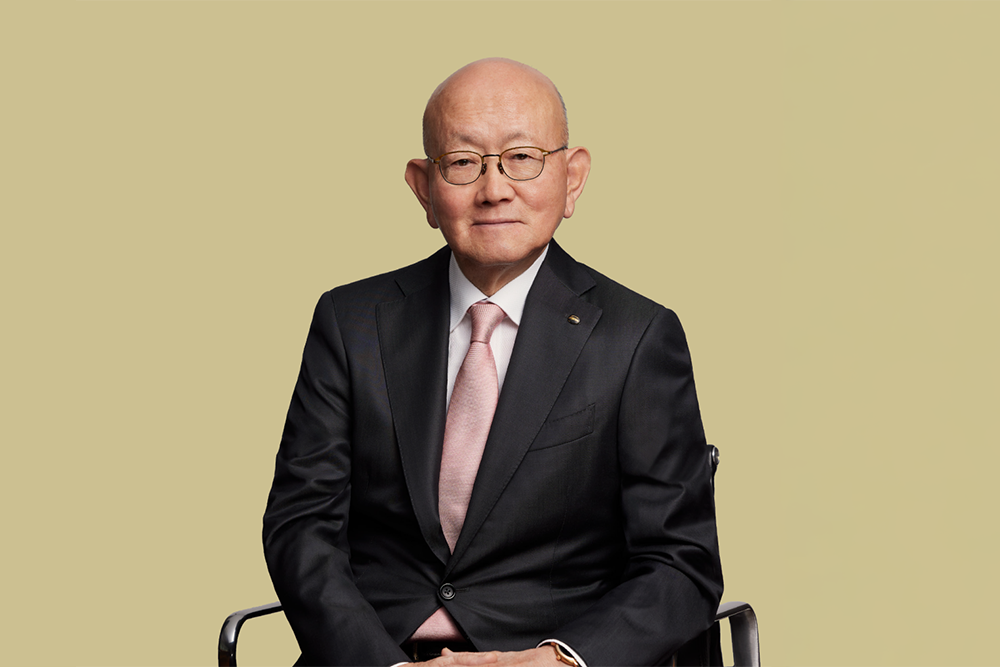
“Don’t Favor Only the Most Respectable”Junnosuke Inoue


Masahiro Okafuji
Chairman & Chief Executive Officer
Questioning the Conventional Wisdom
Looking across the world today, I sense that the seeds of major change are beginning to emerge amidst the turmoil.
I joined ITOCHU Corporation in 1974, in the midst of the first oil shock. More than 50 years later, who could have imagined that we would once again face what might be called a Reiwa-era oil shock In Japan as well, we are now at a major turning point: many assumed that deflation would continue indefinitely, but now we are moving into an inflationary phase for the first time in more than 30 years. Today, prices are rising across the board and while people living in Japan may understand this intellectually, they may still find it difficult to adjust emotionally. I am keenly aware every day how challenging a phase this is for steering a company. The conventional wisdom of the past is no longer sufficient. We will not be able to overcome the difficulties before us unless I too begin by questioning the conventional wisdom.
Against that backdrop, one line in a book I happened to pick up recently stayed with me: “Don’t favor only the most respectable.” Looking into the phrase further, I found that it is attributed to Junnosuke Inoue, who served as the Minister of Finance as well as the Governor of the Bank of Japan from the Taisho era into the early Showa period. He, too, was someone who refused to be constrained by the conventional wisdom. The true intent of the phrase appears to have been that people who speak only in conservative, conventional terms do not produce original ideas or the capacity to overcome difficult situations. In corporate management, unexpected problems arise all the time. Speaking from my own experience as a manager, I found the point deeply persuasive. As I explored the background further, I also came to realize that ITOCHU has a meaningful historical connection to Inoue.
That connection began when Chubei Itoh II stopped in New York on his way to study in the United Kingdom. He visited Inoue, who was then stationed there in his capacity as the official overseeing the Bank of Japan’s New York office. During that visit, Inoue commented on Chubei Itoh II’s tendency to reject people who did not fit into the mold and to favor only respectable people, and urged him to change his approach. Thereafter, Chubei Itoh II held Inoue in the highest regard and reportedly sought his counsel whenever the occasion arose. In his later memoirs, he described these as “the strongest words anyone has ever said to me.”
During a dialogue I had with Hideki Kuriyama, who led Samurai Japan to victory, I happened to mention Inoue. To my surprise, I later received a letter from Inoue Shuzo, the sake brewery founded by his family, and had the opportunity to meet them. Inoue Shuzo has been brewing sake in Oita Prefecture for more than 200 years, and at a time when sake brewing was considered strictly a male domain, it took the pioneering step of having women engage in brewing. I was also told that Yuri Inoue, their seventh president, accepted both capital and management personnel from an Oita-based fund established to foster outstanding local industries, and then pressed ahead with management reform. Rather than limiting herself to utilizing Inoue’s ancestral home and brewery (both historically significant cultural properties), she decided to devote herself to the role of master brewer so that the business could continue for another 300 or 400 years. Hearing this story of taking on new challenges without being constrained by conventional wisdom about what a sake brewery should be, I felt both a strange sense of connection with Junnosuke Inoue, who opened up a new era by questioning conventional wisdom, and with Inoue Shuzo, which carries on that spirit. It was also a powerful reminder to me of how important it is today to question what is taken for granted.
The saying, “Great achievements are made in times of hardship; many undertakings fail in times of success,” was the personal motto of President Masakazu Echigo, who is regarded as one of the principal figures in our company’s postwar revival. But I later discovered that it originally came from Inoue. These important words have been passed down within ITOCHU to the present day.
Common Sense in Corporate Management
Corporate management, too, is full of conventional wisdom that should be questioned.
Take engagement surveys, for example, which have recently drawn attention as a way of gauging corporate culture. I am somewhat concerned by the tendency to pursue only one outcome: high employee satisfaction. A female officer of our company recently exchanged views with female officers from other companies, and one topic came up in the discussion: one company was relieved to very high engagement survey results, but a closer look into the details revealed that many employees had hardly come to the office for an entire month and had been working almost entirely from home. In other words, easier working conditions had become one of the reasons behind the improved results.
Work-style reforms that place excessive emphasis on making things easy may impede corporate growth and also limit the room individuals have to develop. Management is expected to sustain a virtuous cycle where employees feel a sense of purpose and make continuous efforts, management converts those efforts into better business performance, and employee benefits reflect those results; employees, in turn, are able to achieve more fulfilling lives.
The same applies to diversity. It has become conventional wisdom to set numerical targets for categories such as women or foreign nationals. But is such a formalistic approach really the right one for corporate management, which must deliver on growth What is truly necessary is to create an environment in which we can listen to a wide range of people, including those with unconventional ideas, so that we can make our way through any difficult situation. People who appear to be model performers but only repeat the conventional wisdom lack the unconventional thinking, flexibility, and dynamism to solve difficult problems. If an organization is composed only of such people, it will not be able to deal with the unexpected. That is why it is so important to build a diverse team and place every perspective raised by that team on the table before making the best possible management decision. I regard that as one of the most important responsibilities of top management, including my own. In that sense, corporate management in the current environment brings us back, once again, to the words of Inoue.
A Merchant’s Successor
In December 2025, Warren Buffett stepped down from the CEO position he had held for so many years at Berkshire Hathaway. His final shareholder letter was, as one would expect from the “Oracle of Omaha,” full of insights that deeply affected me. Buffett touched on his management philosophy in selecting a CEO and listed several traits that make someone unsuitable as a successor or as a top executive.
- A person who tries to build a dynasty: someone driven by self-display, obsessed with standing out or creating an “era,” and inclined to put personal interest ahead of the company’s interest.
- A person who openly boasts about being wealthy, displaying the arrogance of possessing vast personal assets.
- A person who publicly declares his retirement age, purposefully stirring outside speculation.
I imagine many people would find those points convincing. They also reminded me of the case discussed in The Man from Tehran by Hiroshi Kodama, a book I referred to in a previous message, in which a mistake in selecting Toshiba’s successor ultimately led to organizational collapse.
In Japan, it is common for top executives to rotate after about six years on average. I question whether that is enough to practice true management from a long-term perspective. If people are highly capable, they should be given the opportunity to continue serving as officers for a longer period. In fact, our former CFO and CAO each supported the Company’s remarkable progress for more than 10 years. Their contributions are recognized by all.
Selecting a successor is difficult for any company. In my view, one quality that the head of a general trading company must absolutely possess is a merchant’s instinct. The person must have produced results on the front-lines of business, where conditions change constantly. He or she must also be able to think independently, question conventional wisdom, and make prompt decisions as circumstances evolve from moment to moment. A deep understanding of the importance of Group management is equally essential.
In fact, for FY2026 we appointed two individuals as headquarters officers who had previously gone on to deliver outstanding results in the management of Group companies after leaving headquarters. We also ensure that our Outside Directors meet many of our officers and the managements of our Group companies, and that views are exchanged constantly from every possible angle.
“Merchants need to be like water” is a business philosophy and also one of the qualities required of a manager. It means having the flexibility to change constantly in accordance with the counterpart, just as water changes shape depending on the vessel. Business cannot be built without empathy. The same is true with the market. ITOCHU is committed to cultivating managers of precisely that kind.
Reaffirming “No Growth without Investments” and Consistent Management
Tsutomu Fujita, a well-known strategist on Japanese equities and now the representative of the Capital Markets Research Forum at Hitotsubashi University, recently contributed an opinion piece to the Nikkei warning against the view that Japanese companies hold excessive retained earnings and should therefore increase shareholder returns.
I share the sense that the current Japanese market has a tendency to prioritize shareholder returns first. As many people know, Amazon, one of the major global technology companies, generated net profit of ¥12.4 trillion, while making capital expenditures of ¥20.5 trillion and total growth investments of ¥38 trillion including research and development expenses. Since its listing in 1997, it has not paid a single dividend. Yet its market capitalization has reached an extraordinary ¥420 trillion, something difficult to imagine in Japan. Even Toyota, by contrast, has a market capitalization of roughly ¥45 trillion and R&D expenses of ¥1.5 trillion. This is exactly why I say, “No growth without investments.”
Management at major technology companies, pursuing growth investments on such an extraordinary scale, may appear far outside the conventional wisdom. This is admittedly an extreme example, but I believe that what matters above all is the balance between growth investments and shareholder returns. Massive shareholder returns may provide a temporary boost to the share price, but they also carry the risk of cutting off future growth. For a company like ours, which must compete globally, unbalanced management decisions can be fatal, and would not serve Japan as a whole, either. The same holds true for portfolio management. Merchants need to be like water, and ITOCHU’s approach to management is to maintain a broad portfolio and flexibly shift the center of gravity in line with the needs of each era. The approach we have pursued on that basis is consistent management. It is a way of thinking that seeks to raise the performance of the portfolio as a whole, not by becoming excessively dependent on any one business, but by building on strengths while steadily addressing weaknesses.
Take ITOCHU’s Machinery Company, for example. In FY2010, its profit was the smallest among all segments and did not even reach ¥10.0 billion. Today, it is on pace to exceed ¥200.0 billion. I believe this is an achievement that could never have been realized through the conventional logic of “focus” alone.
A Rebound from Undervaluation—Toward the Next Stage of Growth
For many years, general trading companies were not highly valued, no matter how much profit they generated; trading company shares were perennially undervalued. In recent years, however, the market’s evaluation of the sector has risen sharply. Our own share price has continued climbing from the ¥800 range at the time I became president, and at one point surpassed the ¥10,000 level on a pre-stock-split basis. Among all listed companies, ITOCHU is also the only one to have outperformed TOPIX for 11 consecutive years through the end of FY2025. At one point, a trading company even ranked among the top three listed Japanese companies by market capitalization. This reflects a broad reassessment of general trading companies in terms of profit levels, shareholder returns, company rankings by jobseekers, and overall standing in society. It is an extremely welcome development for the industry as a whole.
Recently, Yasuhiro Narita, an analyst at Nomura Securities who covers the trading company sector, published a report on our shares under the title “A Rebound from Undervaluation Begins.” The substance of the report was that while ITOCHU is not benefitting in the short-term from persistently high energy prices caused by the prolonged Middle East conflict, given our relatively low share of earnings derived from the energy sector, the recent adjustment in our share price has made the stock appear increasingly undervalued. It also argued that momentum in the share price should improve once the conflict ends and energy markets stabilize with improvements in our core earnings becoming evident.
I read all reports issued by sell-side analysts. This particular report left me with a renewed sense of responsibility and strengthened my determination to meet the market’s expectations.
This year, we will once again put our policy of “No growth without investments” into practice. We are currently working on a range of initiatives aimed at new growth, and some of them will be announced soon. I myself am committed to taking the lead in achieving high-quality investments, and will put in the hard work, endeavoring with each Division Company President to develop new business. I also continue to visit clients and Group companies in person, sharpening my instincts as I go about management every day.
This year, we plan to deliver solid results in the form of the sustainable enhancement of corporate value, and look forward very much to sharing them with you.
- “Sampo-yoshi” and Management Philosophy
- Management Message
- Value Creation
- Mechanisms and Practices of Value Creation
—Business Model— - On the Front Lines of Value Creation
- Corporate Governance
- Corporate Governance System
- Board Effectiveness Evaluation
![[PDF]](/en/common/img/com_pdf_ic01.png)
- List of Directors and Audit & Supervisory Board Members
- Director Selection Criteria / Succession Planning
- Messages from Outside Directors and Audit & Supervisory Board Members
- Corporate Officer Remuneration
- Policy on the Governance of Listed Subsidiaries and Affiliates
- Data / Dialogue with Stakeholders