Collaboration with Outside Initiatives
Participation in Initiatives
We participate in the following initiatives to promote sustainability.
Involvement in the United Nations Global Compact

In April 2009, ITOCHU Corporation joined the United Nations Global Compact, a global initiative to achieve sustainable growth for the international community. We will fulfill our corporate mission of Sampo-yoshi in accordance with the United Nations Global Compact’s 10 principles covering human rights, labor, environment and anti-corruption.
The Ten Principles of the United Nations Global Compact
| Human Rights |
|
| Labour |
|
| Environment |
|
| Anti-Corruption |
|
Work with Global Compact Network Japan
ITOCHU is the corporate director of Global Compact Network Japan (GCNJ), the local network for the United Nations Global Compact in Japan. The GCNJ learns from other companies’ practices and academics, and also consists of subcommittees for deliberations and exchanging ideas on specific topics concerning approaches and initiatives for sustainability. In FY2025, ITOCHU participated in the ESG Subcommittee and the Human Rights Education Subcommittee.
TNFD Forum
ITOCHU supports the principles and activities of the TNFD which promote disclosure of the impact of nature-related risks and opportunities on corporate business and financial accounting. In June 2022, we joined the TNFD Forum to gain experience and knowledge. Subsequently, October 2024, we also registered with TNFD Adopters. Through the forum, we have been gathering information on TNFD and is committed to appropriate disclosure in accordance with the TNFD Recommendations.
CDP (Climate Change, Water Security and Forests)
ITOCHU is actively providing information on ESG initiatives to various stakeholders around the world. As part of these initiatives, we have been responding to climate change, water security and forests questionnaires of the CDP, which is recognized worldwide as a global standard for corporate environmental information disclosure.
- Please refer here (PDF: 5.9MB)
 for our company’s latest answers to CDP Questionnaire 2026 for climate change, water security, and forests
GX Future Consortium/GX Future League
ITOCHU announced its support for TCFD, which encourages companies to disclose financial information related to climate change, and participated in the TCFD Consortium, established in 2019 by the Ministry of Economy, Trade and Industry (METI), Ministry of the Environment (MOE), and the Financial Services Agency (FSA). In 2022, ITOCHU expressed its support for the GX League Basic Concept established by the METI, and has been actively involving and making proposals at the public-private councils regarding the concept of emissions trading, the carbon credit market, and the ideal way to trade credits in the GX League. We also participated in the GX League, which began in earnest in April 2023.
Furthermore, in April 2026, the GX Future Consortium, which integrates the functions of the TCFD Consortium and the GX League, was established, and within it, the GX Future League was formed. The league inherits the functions of both the TCFD Consortium and the GX League, and was established as a new framework to promote collaboration among companies and rule-making, in anticipation of increasing GX-related demand driven by the full implementation of the emissions trading system.
We will continue to actively participate in the GX Future Consortium and the GX Future League, contributing to the virtuous cycle of the environment, economy, and society, including climate change.
Japan Climate Initiative (JCI)
ITOCHU participates in the Japan Climate Initiative (JCI), a network of Japanese non-governmental actors actively working to achieve the 1.5-degreegoal. This network gathers companies, local governments, organizations, and NGOs who support the idea of “Joining the front line of the global push for decarbonization from Japan.” With the active commitment of the Director in charge, the staff of the Sustainability Management Division participates in various seminars and other activities held by JCI to keep up with the latest trends of climate-related issues in Japan and overseas. In addition, we disclose information on our commitment and initiatives toward the decarbonized society on the JCI’s website. In 2025, we endorsed the “Japan Climate Action Summit 2025 Declaration” advocated by JCI. This declaration demonstrates our strong commitment, as a member of JCI, to realizing a decarbonized society. Please refer here for more details.
Japan Partnership for Circular Economy (J4CE)
ITOCHU is participating in the Japan Partnership for Circular Economy, a public-private collaboration established by the Ministry of the Environment, the Ministry of Economy, Trade and Industry, and the Japan Business Federation. This initiative aims to foster a deeper understanding and promote efforts towards a circular economy. Among more than 200 registered companies, the spotlight case collection released in 2025 features our textile company, which invests in and collaborates for the production of recycled polyester RENU. It highlights the resource circulation service PASSTO, which seamlessly conducts the collection, sorting, and redistribution of unused items.
RSPO (Roundtable on Sustainable Palm Oil)
Please refer here for details of our activities.
GPSNR (Global Platform for Sustainable Natural Rubber)
Please refer here for details of our activities.
KEIDANREN (Japan Business Federation)
- Committee on Environment
- 1% (One Percent) Club
- Council for Better Corporate Citizenship (CBCC)
- Committee on Responsible Business Conduct &
SDGs Promotion - Keidanren Nature Conservation Fund /
Keidanren Committee on Nature Conservation
Japan Foreign Trade Council (JFTC)
- Sustainability Promotion Committee
- Social Contribution & ABIC Committee
ESG Disclosure Study Group
Stakeholder Engagement
Policy & Basic Approach
In our diverse range of corporate activities conducted worldwide, ITOCHU Group place strong emphasis on dialogues with various stakeholders. We provide information about the Group activities, and we value the opinions of our stakeholders, both expectations and concerns. For our sustainable growth, we reflect measures in our business activities to further advance sustainability on a company-wide basis.
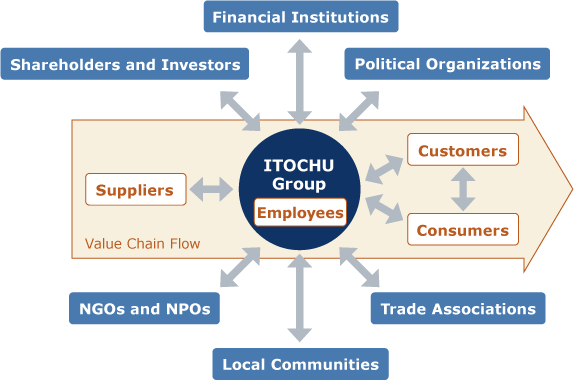
| Stakeholders | Frequency | Overview of Initiatives | Main Methods of Dialogue |
| Suppliers, Customers, and Consumers | Periodically As Needed |
We engage in fair and equitable transactions with business partners and comply with laws and ordinances. By building supply chain management that addresses social issues in human rights, labor and environment, we strive to provide safe and secure products and services to consumers. |
|
| Shareholders, Investors, and Financial Institutions | Periodically As Needed |
We emphasize dialogue with our shareholders, investors, and other stakeholders from the perspective of achieving sustainable growth and enhancing corporate value over the medium to long term. We strive to reflect obtained inputs into our management strategies and financial and capital policies. Through commitment-based management, we expand corporate value and sustain a positive cycle through effective engagement. |
|
| Political Organizations, and Associations | As Needed | We aim for the settlement of social issues and the sustainable development of the international community. We do this by complying with various relevant laws and ordinances formulated by government agencies and local governments in Japan and overseas. In addition, we promote business in cooperation with government agencies, local governments and industry groups. |
|
| Local Communities, NGOs, and NPOs | As Needed | We understand that our business activities affect local communities. Accordingly, we contribute to the sound and sustainable development of local communities. We do this by aiming to solve social issues in communities such as the creation of jobs, development of infrastructure, improvements in living standards and development of the educational environment. We strive to solve social issues through dialogue and collaboration with NGOs and NPOs. |
|
| Employees | As Needed | We endeavor to develop various measures and systems to realize decent work with aiming a challenging but rewardng company. We work to foster an organizational culture in which diverse human resources create opportunity of self-development and social contribution through their work. |
|
The Expense of Associations and Social Contribution
(Unit: 1 million yen)
| Subject | FY2023 | FY2024 | FY2025 |
| Lobbying | 0 | 0 | 0 |
| Trade Association, Economic Association, etc. | 91 | 70 | 393 |
| Political Association | 32 | 28 | 30 |
| Other | 0 | 0 | 0 |
| Total | 123 | 98 | 423 |
| Social Contribution (Donation) | 1,971 (161) | 1,941 (154) | 1,919 (477) |
Major Donation Cases in FY2025
(Unit: 1 million yen)
| Subject of Donation | Amount | Summary | |
| General Incorporated Foundation National Political Association | 28 | Corporate donations to the National Political Association | |
| Imabari City, Ehime Prefecture | 50 | Donation to support projects for Imabari city’s local development | |
| EU-Japan Fest Japan Committee | 3 | Donation as part of a cultural exchange regarding a program to promote artistic and cultural exchange between Europe and Japan | |
| Shiga Prefecture | 1 | Donation to support the environmental policies of Shiga Prefecture, the birthplace of our company | |
Consultation Desk for the General Public (including Stakeholders)
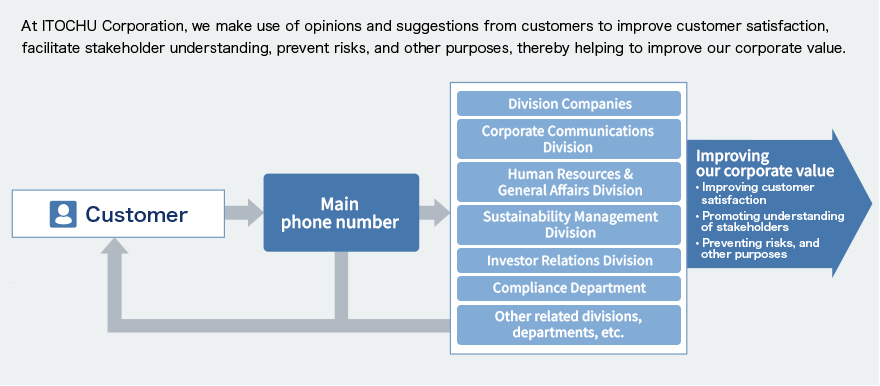
ITOCHU Corporation has established a system to accept opinions, proposals, and grievances and to accept inquiries from the general public and all our stakeholders, as described below.
Third Party Opinion
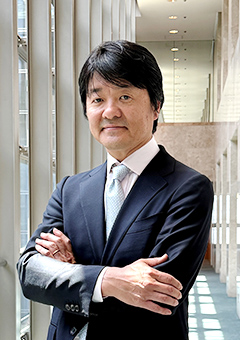
CEO
Institute for Sustainability Management
One of the most noteworthy features of this report is the significant progress made in its disclosures based on the TNFD recommendations. The report presents analyses of sectors identified as highly material through dependency and impact mapping, and, importantly, each of these is examined in detail along the value chain. This provides highly meaningful insight. It is also important that these efforts involve frontline sales personnel in each case, ensuring that the initiatives are grounded in on-the-ground realities rather than remaining purely desk-based analyses. For example, in the area of natural rubber, the knowledge and experience cultivated through PROJECT TREE have clearly been put to good use.
In the past, sustainability discussions tended to focus mainly on globally shared challenges such as climate change. While progress on these issues remains insufficient, society is now also facing rising regional risks, including geopolitical and geo-economic tensions, alongside major changes driven by advances in digital technologies such as AI. These developments are having a profound impact on sustainability and resilience not only at the national and regional levels, but also within smaller communities and organizations. As a general trading company, ITOCHU Corporation is well positioned to draw on its diverse business portfolio and to help guide society toward a more sustainable future, addressing challenges from the global to the local, while maintaining an appropriate balance through new business initiatives.